 Software Keys HQ
Why Your Antivirus Renewal Costs Two to Three Times Year One
Your antivirus renewal doubled because year one was an introductory rate. Why the jump happens, and the four realistic options for avoiding it.
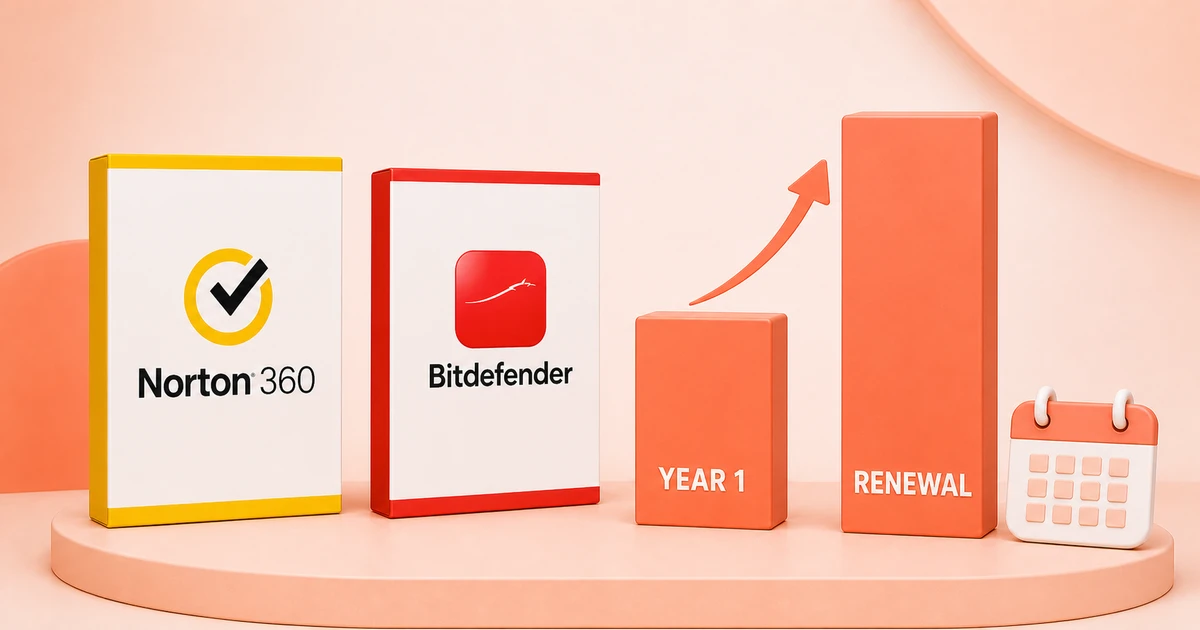
That first-year price was an introductory offer. Here is what actually happens at renewal, why the jump is so steep, and what your options are.
You paid a modest amount for antivirus last year. This year the renewal notice arrives and the number has doubled, sometimes tripled. Nothing about your subscription changed. Here is why that happens, and what you can do about it.
The first-year price was never the real price
Almost every major antivirus brand sells the first year at a discount and renews at list price. The introductory rate is a customer-acquisition cost: the vendor accepts a thin margin, or none, to get you into the subscription. The renewal is where the product is actually priced.
That is legal, disclosed in the terms you agreed to, and completely standard across the industry. It is also why the jump feels like a mistake when it is not.
Why the jump is so large
Three things compound:
- The discount disappears. A first-year promotion is frequently half off or better, so renewal alone can double the figure.
- List prices drift upward. The renewal is charged at whatever the current list price is, not the list price when you signed up.
- The tier may have changed. Vendors reshuffle product lines regularly. A suite you bought as a mid-tier product may now renew into a more expensive bundle that includes a VPN, password manager or identity monitoring you never asked for.
Auto-renewal is on by default
The renewal usually charges the card on file before the notice fully registers. Most vendors send the reminder a few weeks ahead, but it arrives as one email among many, and the charge lands whether or not you opened it.
This is the part worth acting on early. Turning auto-renewal off does not cancel your protection — your current term runs to its end date. It only stops the automatic charge, which converts a surprise into a decision.
Your realistic options
Renew and pay list price. Simplest, and defensible if you value the specific product. Just do it knowingly rather than by default.
Call and ask for a retention offer. Antivirus vendors have retention teams with discretion to discount. This works often enough to be worth fifteen minutes, though it typically only defers the problem another year.
Buy a fresh licence instead of renewing. A new licence key for the same product is usually far cheaper than the renewal rate, because it is priced as an acquisition rather than a renewal. This is the option most people do not realise exists.
Switch products. If the renewal has pushed you into a bundle you do not use, a different vendor at its introductory rate may cover what you actually need for less.
Where buying a key fits
If you decide against paying the renewal rate, a licence key is the same product at acquisition pricing. Antivirus keys here are genuine, publisher-issued licences, sold in one to three year terms and one to ten device counts, so you can match the licence to what you actually run rather than to whatever bundle the renewal defaults to.
The practical sequence is: turn off auto-renewal first so nothing charges unexpectedly, let your current term run to its end date, then activate the new key. You lose no coverage, and you are not paying twice for overlapping periods.
What to check before you buy anything
- The term. One year and three year licences are priced very differently per year. Three year terms are usually the better value if you intend to stay with the product.
- The device count. Paying for ten devices when you protect two is the other common way people overpay.
- Whether it is a renewal code or a new licence. These are not always interchangeable. A new licence is what you want if you are moving off the renewal price.
The short version: the renewal figure is not a mistake and it is not negotiable by default, but it is avoidable. The only real error is letting it charge automatically before you have decided.
Related guides
- How to Turn Off Antivirus Auto-Renewal Before It Charges You
- The Cheapest Way to Renew Your Antivirus in 2026
- Bitdefender vs Norton: Which Antivirus Should You Buy in 2026?
Shop software keys — Windows, Microsoft Office, antivirus and business licenses, delivered fast.